
Reading Time: 7 mins
9th April 2026
Children and young people are surrounded by a constant flow of online news, much of it shared rapidly across social media. Alongside mainstream news updates, they can be exposed to AI‑generated posts, graphic and unverified footage, and disturbing narratives. As a result, they may want to discuss distressing topics they have seen online with the adults in their lives.
For professionals, parents and carers, this guidance offers practical support to help you navigate difficult topics sensitively and in age‑appropriate ways, while encouraging healthier engagement with current events and the world around them.

Where do children and young people receive the news?
Ofcom (2025) found that social media is now the primary news source for 71% of 16-24-year-olds, with TikTok established as the top news source for young teens. With 37% of children as young as 3-5-years-old already accessing social media platforms, it is highly likely that the next generation will be similarly in favour of online news consumption.
Although there are plenty of reputable sources on these platforms, social media can function as a breeding ground for fake news, including misinformation (false information shared that someone believes to be true) and disinformation (false information deliberately shared to deceive or mislead).
AI is increasingly used to make fake news look more convincing, allowing users to create believable images to accompany fake headlines. In 2026, BBC Verify disproved AI-generated videos of explosions in the Middle East that had received hundreds of millions of views despite being completely fabricated.
BBC Verify investigate circulating news stories which seem inaccurate and publish their findings on their webpage. This resource can help you and the young people in your care to determine what is true in the news today.
The news and algorithms
As so many children and young people receive their news updates from social media, their algorithms can determine the volume and types of news that repeatedly appears in their feed. An algorithm is a formula that curates the ‘perfect’ tailored social media feed for every individual, based on what they interact with online. Unfortunately, this means that anytime a person watches a video or likes a photo that could be linked to distressing material, more material like this will appear. It makes it harder to escape from the constant stream of news available online and young people can stumble across something they are not prepared to see.

Top Tip!
Our Safer Schools Digital Proficiency Course covers fake news and cautions children to question shocking or suspicious headlines, recommending the “two tab” rule to investigate whether another reputable news source has reported it. Likewise, the course covers algorithms and how to use functions such as “Not Interested” to take control of their social media feed.
You can view the Digital Proficiency Course within your Safer Schools web and mobile app today, available for children, young people, parents/carers and professionals.


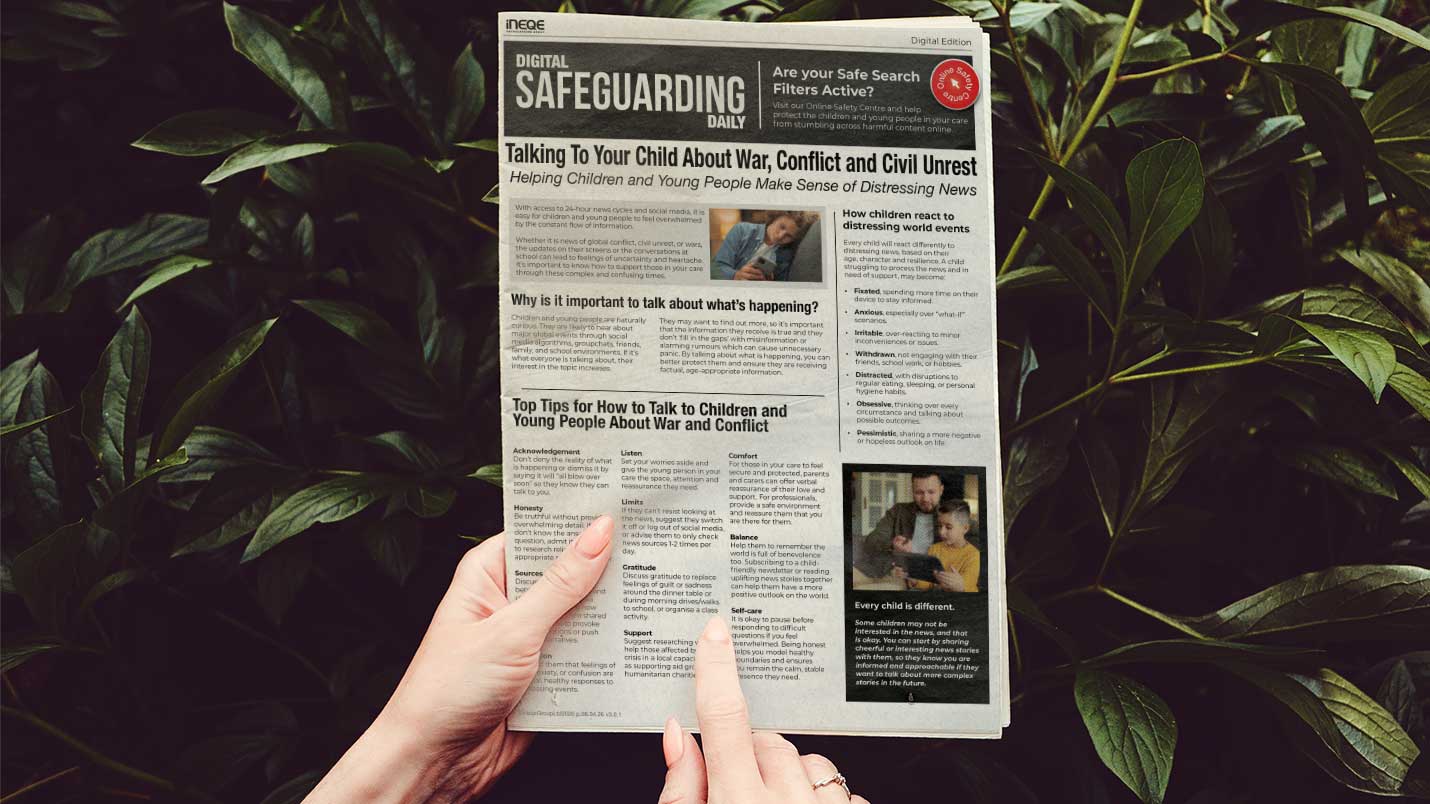
How children react to distressing world events
If someone in your care is struggling to accept or process distressing news, they might become:
If you are worried about a child or young person, you can encourage them to speak to you or another trusted adult or to Childline’s support services.
Why can the news be difficult to process?
Several aspects of modern reporting make the news hard to deal with daily:

Why is it important to talk to children and young people about what’s happening?
Children are naturally curious and will inevitably hear about world events from school or social media. If you don’t acknowledge their questions, they could fill in the gaps with wrong information, which often causes more anxiety than the truth itself. It’s also healthy for children and young people to have an interest in the news as it expands their minds to better understand the complex world around them.
By being the one to educate them, you can help them process news at their own pace and comfort them if they need reassurance. You don’t need to be an expert; being a trusted adult means being a reliable source even if you don’t have all the answers.
Talking it through, allowing space for questions and discussion, ensures they know how to process news reports on their own with critical thinking and media literacy skills.
Top Tips for the Conversation
Every child is different. Their ability to process information will depend on their age, character, and resilience. As one of their trusted adults, you will know them well, so you can assess the level of information you share with them and how to go about it. Here’s some practical tips to help you navigate the conversation:
Use your words and actions to support them
Your reactions to their concerns are key to helping those in your care feel protected and loved. For parents/carers, tell your child you love them and give them hugs. For teachers and professionals, ensure you provide a safe, calm environment and reassure them that they are supported.
Protect your own wellbeing
Discussing global conflict can be emotionally demanding and it is okay to pause before answering a child’s questions. If feeling overwhelmed, you can say, ‘I see you’re worried. I’m still processing this too. Can we talk later when I’ve had time to think?’
Prioritising your personal wellbeing ensures you remain the calm, stable presence they need.
Key Resources



Join our Online Safeguarding Hub Newsletter Network
Members of our network receive weekly updates on the trends, risks and threats to children and young people online.